HiTech Creations should seriously consider implementing AI-assisted moderation in Aces High because it could improve the gaming experience, reduce player harassment, help retain existing subscribers, and make the game more welcoming to new players — without requiring HiTech to constantly monitor the arenas.
For a smaller, long-running multiplayer game like Aces High, keeping players is especially important. A handful of disruptive individuals can negatively affect an entire arena.
## 7 reasons HiTech should implement AI moderation
### 1. Reduce harassment and personal attacks
Aces High is a competitive game, and trash talk has always been part of its culture. There's a difference, however, between friendly rivalry and repeated personal harassment.
AI could help identify:
- Repeated personal insults targeting particular players.
- Threats and discriminatory abuse.
- Players deliberately provoking arguments.
- Persistent harassment across multiple gaming sessions.
Benefit: Players could enjoy competitive banter without having to tolerate sustained abuse.
### 2. Protect the player population
Aces High depends heavily on its established community.
If a new player enters the Main Arena and encounters constant hostility, they may simply leave rather than renew their subscription.
AI could flag patterns of abusive behavior before they drive people away.
Benefit: Better player retention and a more inviting environment for newcomers.
### 3. Provide moderation 24 hours a day
HiTech cannot realistically have human moderators watching every arena around the clock.
An AI moderation system could review text communications automatically, identify potential violations and forward serious incidents to an administrator.
It could cover the Main Arena, AvA Arena, Special Events and other multiplayer environments.
Benefit: Consistent moderation without hiring a full-time moderation staff.
### 4. Distinguish friendly trash talk from actual harassment
This is particularly important in Aces High.
Players have known one another for years, and competitive insults are sometimes part of established friendships.
A well-designed moderation system should consider context rather than simply censoring particular words.
For example:
| Player comment | Suggested response |
| --------------------------------------- | ----------------------------------- |
| "You fly like a drunken squirrel!" | No action |
| "Nice HO, dweeb!" | No action |
| Repeated targeted personal abuse | Warning or review |
| Credible threats against another player | Immediate human review |
| Repeated harassment after warnings | Temporary communication restriction |
Benefit: Preserve the character of Aces High without allowing individuals to ruin the experience for others.
### 5. Identify repeat offenders
Rather than treating every incident independently, AI could identify patterns of repeated misconduct.
For example, a player who continually targets the same individual over several weeks could be flagged for review.
The system could recommend progressive actions, such as a warning, temporary text-channel mute or referral to HiTech for further action.
Benefit: Focus moderation on sustained disruptive behavior rather than isolated arguments.
### 6. Improve fairness and accountability
One common complaint in multiplayer games is inconsistent enforcement.
An AI-assisted system could help apply the same published standards to everyone, regardless of squad affiliation, experience or personal relationships.
Players should also have a way to appeal moderation decisions.
Benefit: Greater confidence that rules are being applied fairly.
### 7. Reduce HiTech's administrative workload
Instead of personally investigating every complaint, HiTech could receive a concise incident report containing relevant messages, timestamps, applicable rules and any previous warnings.
Human administrators would retain control over significant disciplinary decisions.
Benefit: Less time handling disputes and more time developing and improving the game.
## How an AI moderation system could work
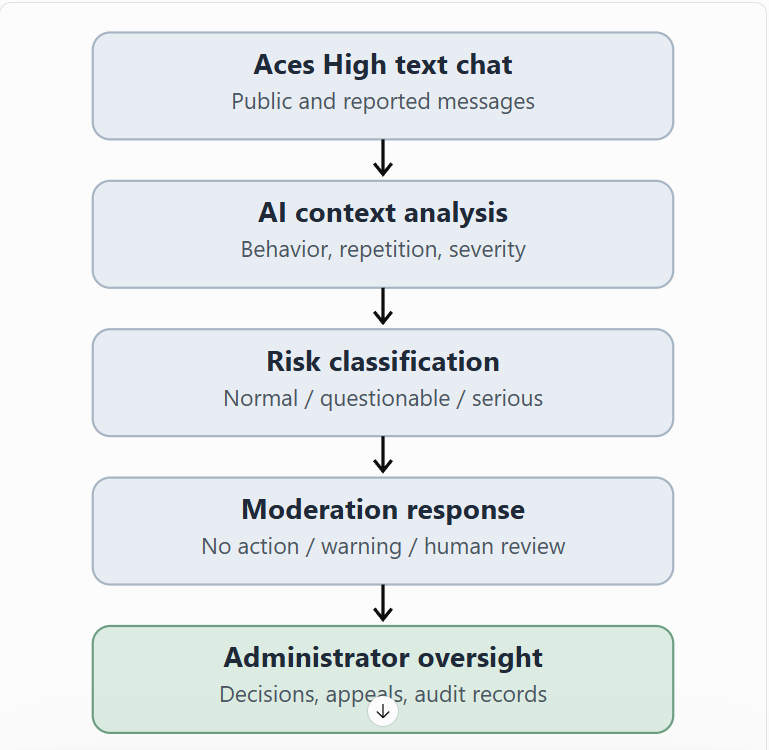
Example of an AI-assisted moderation workflow with human oversight.
## What HiTech should NOT do
The system should not automatically ban players simply because someone reports them or because they use colorful language.
It should also avoid:
- Censoring ordinary competitive trash talk.
- Punishing players based solely on AI-generated scores.
- Monitoring private conversations without clear disclosure and appropriate safeguards.
- Allowing players to weaponize false reports against rivals.
- Using automated voice transcription without evaluating accuracy, consent and privacy concerns.
The AI should assist human moderators, not replace their judgment.
## What would it cost?
A modest system focused on text chat could be considerably less expensive than a comprehensive system that monitors live voice communications.
| Implementation | Illustrative cost |
| ----------------------------------- | ----------------------- |
| Basic text filtering and reporting | $500–$2,000 setup |
| AI contextual text moderation | $2,000–$8,000 setup |
| Monthly text processing and hosting | $25–$200 |
| Voice moderation and transcription | Higher, usage-dependent |
These are rough planning estimates, not vendor quotations. Actual costs depend on how Aces High exposes chat data, the number of active players and whether HiTech develops the integration internally.
## My recommendation for Aces High
I would recommend a 90-day pilot program that monitors public text channels, flags serious incidents for human review and measures false positives, complaints and repeat incidents.
HiTech could begin with warnings and reporting rather than automated punishment. Only after demonstrating accuracy should it consider automatic temporary mutes for narrowly defined violations.
The goal should not be to turn Aces High into a politically correct, heavily censored environment. It should be to protect the game's competitive culture while preventing persistent harassment from driving paying customers away.
And that raises an important business question:
How many paying Aces High subscribers have left because of the behavior of other players?
If AI-assisted moderation prevents even a modest number of cancellations, it could potentially pay for itself.


